
Why Your Feet Deserve More Attention Daily
Think about everything you did today. You got out of bed, walked to the bathroom, stood at the kitchen counter making breakfast, perhaps commuted to work or ran errands, then spent hours on your feet before finally sitting down again. Your feet were involved in every single moment of that, and the chances are you did not think about them once.
Most people spend time and money on skincare, hair care, dental hygiene, and fitness. Yet the part of the body that literally carries everything else tends to get the least daily attention. We notice our feet when something hurts. Until then, they are easy to ignore.
That pattern is worth changing, and the good news is that it does not take much to make a real difference.
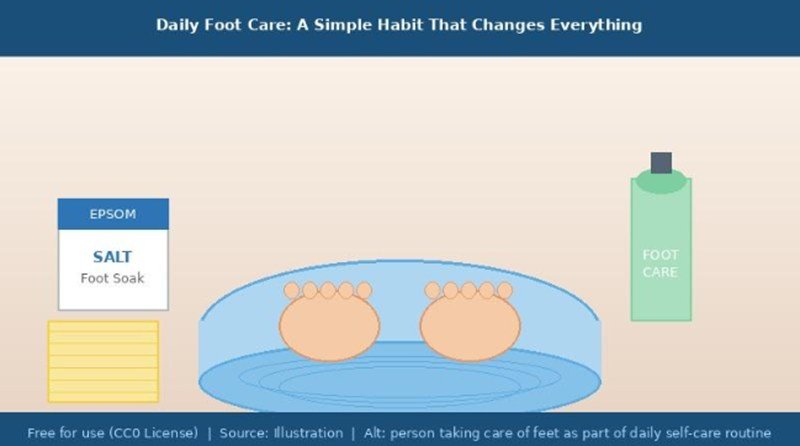
Daily Foot Care: A Simple Habit That Changes Everything | Free for use (CC0 License) | Alt text: person taking care of feet as part of daily self-care routine
Your Feet Do More Work Than You Realise
The average person takes between 6,000 and 10,000 steps each day. Each step places a force equivalent to roughly one and a half times your body weight through your foot. Over a lifetime, most people walk the equivalent of four times around the Earth.
What makes that even more remarkable is the structure doing all of that work. Each foot contains 26 bones, 33 joints, and over 100 muscles, tendons, and ligaments, all coordinating with each other dozens of times per minute. When everything works as it should, you barely register it. When even one part is under strain, the effects can ripple upward through the ankle, knee, hip, and lower back.
That is why small daily habits matter more than most people expect. You are not just caring for two isolated body parts. You are protecting a complex system that affects how comfortably and confidently you move through every part of your day.
What Happens When Foot Care Gets Ignored
In my clinic, I see the consequences of neglected foot care regularly. The patients who come in with serious discomfort almost always say the same thing: it started small. A little heel soreness in the morning. A toenail that looked slightly off. A rough patch of skin on the heel that never quite went away. By the time they make an appointment, those small things have had weeks or months to develop into something more significant.
Here are the most common conditions that develop when feet are not given consistent daily care.
Plantar Fasciitis
One of the most frequent reasons people visit a podiatrist. It occurs when the plantar fascia, the band of tissue running along the bottom of the foot, becomes inflamed. The signature symptom is sharp heel pain during the first steps of the morning that gradually eases with movement, only to return after long periods of standing or sitting. Poor footwear and inadequate arch support are among the most common contributing factors.
Toenail Fungus
Develops in warm, damp environments and spreads through shared surfaces like gym changing rooms and pool areas. It starts as a small discolouration or thickening but can eventually affect the entire nail and spread to adjacent toes. Once established, it is difficult to clear with topical products alone.
Ingrown Toenails
Almost entirely preventable with correct nail trimming and well-fitting shoes. When left untreated, they break the skin, create a pathway for bacteria, and can become seriously infected, especially in people with reduced circulation or diabetes.
Dry and Cracked Heels
Begin as a cosmetic concern but can deepen into painful fissures that bleed and increase the risk of infection. Anyone with diabetes or poor circulation should treat cracked heels as a medical priority rather than a cosmetic one.
Corns and Calluses
The foot’s response to repeated friction and pressure. Their presence is a signal that something about your footwear or gait is placing abnormal force on a particular area, and that underlying issue is worth addressing.
Paying attention to nutrition and overall body health also plays a role here. Adequate hydration, vitamin intake, and a balanced diet directly affect skin quality, nail strength, and the body’s ability to repair minor damage before it becomes a problem.
Most of these conditions are entirely preventable. That is the part I want people to understand. You do not have to wait until something hurts to take action.
Daily Foot Care Habits Worth Starting Today
None of these habits require special equipment or significant time. They simply require consistency.
- Wash your feet properly every single day, including between the toes where moisture accumulates and fungal infections take hold.
- Dry your feet thoroughly after washing, paying particular attention to the spaces between the toes.
- Moisturise the soles and heels daily to prevent drying and cracking. Apply to the tops and bottoms but avoid between the toes.
- Inspect your feet regularly. Look for changes in skin colour, new sores, thickening or discolouration of the nails, or any swelling.
- Trim your toenails straight across and smooth any sharp edges with a nail file. Never round the corners.
- Wear properly fitting shoes. Have your feet properly measured, as foot size genuinely changes with age.
- Change your socks every day and choose breathable materials that wick moisture away from the skin.
- Elevate your feet for a few minutes after long periods of standing or walking to reduce swelling and improve circulation.
- Stretch the calves and the soles of your feet, particularly in the morning before your first steps of the day.
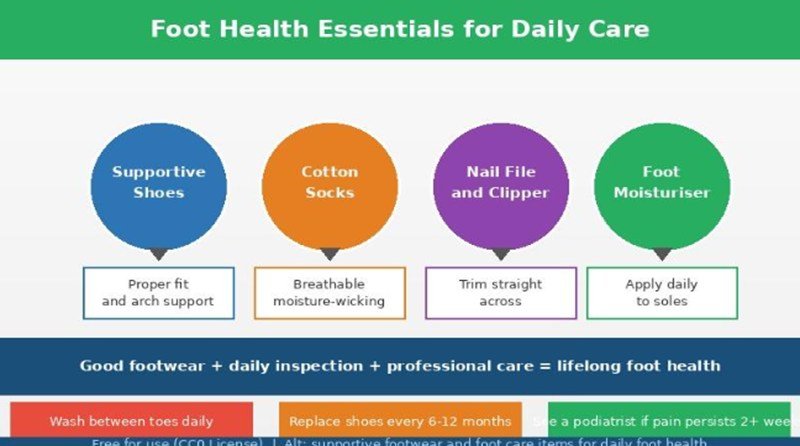
Foot Health Essentials for Daily Care | Free for use (CC0 License) | Alt text: supportive footwear and foot care items for daily foot health
The Role Footwear Plays in Long-Term Foot Health
Shoes are one of the most significant daily influences on foot health, and most people underestimate how much worn or unsupportive footwear contributes to chronic foot problems.
A shoe’s midsole, the cushioning layer between the outer sole and the insole, loses its shock-absorbing capacity long before the outer sole looks visibly worn. If you are running or walking in shoes that have more than 300 to 500 miles on them, you are likely doing so without the support you think you have.
Flat footwear like ballet pumps and flip flops, while convenient, provide no meaningful arch support. Worn occasionally they cause no lasting harm. Worn as daily footwear over months and years, they can be a contributing factor in conditions like plantar fasciitis, flat feet, and tendon strain.
At home, bare feet on hard floors deserve more consideration than most people give them. A pair of supportive house slippers with a firm sole provides a level of protection that going barefoot simply does not.
For those whose foot problems are related to structural issues, incorporating daily wellness advice and general healthy lifestyle habits into a broader self-care routine, including proper footwear choices, makes a meaningful long-term difference. Custom orthotics prescribed by a podiatrist can also correct underlying mechanical problems rather than simply adding cushioning on top of them.
When to Stop Self-Treating and See a Professional
Home care and good daily habits will manage most minor foot concerns effectively. But there are situations where self-treatment is not enough, and recognising the difference is important.
Seek professional evaluation if you notice any of the following:
- Foot pain that has persisted for more than two weeks without improvement
- Any wound or sore that is not healing as expected
- Changes in toenail colour or texture
- Numbness, tingling, or burning sensation in the feet
- Swelling that does not resolve after rest and elevation
- Persistent heel or arch pain that is affecting how you walk
For persistent or recurring foot issues, seeking professional evaluation makes a significant difference in outcomes. A dedicated practice like Beaver Valley Foot Clinic covers a full range of foot conditions and treatments, from ingrown toenails and toenail fungus to plantar fasciitis and diabetic foot care, helping patients address problems at the root rather than managing symptoms indefinitely.
Your Feet Have Earned Better Care
The feet are the foundation of everything your body does in motion. They absorb impact, maintain balance, carry your weight, and adapt constantly to the surfaces and forces you place on them. For most of us, they do that reliably for decades without much acknowledgment.
Five minutes of daily attention, thoughtful footwear choices, and knowing when a problem needs professional input are genuinely enough to protect foot health for the long term. That is not a complicated ask for something that contributes so much to daily comfort, mobility, and quality of life.


