
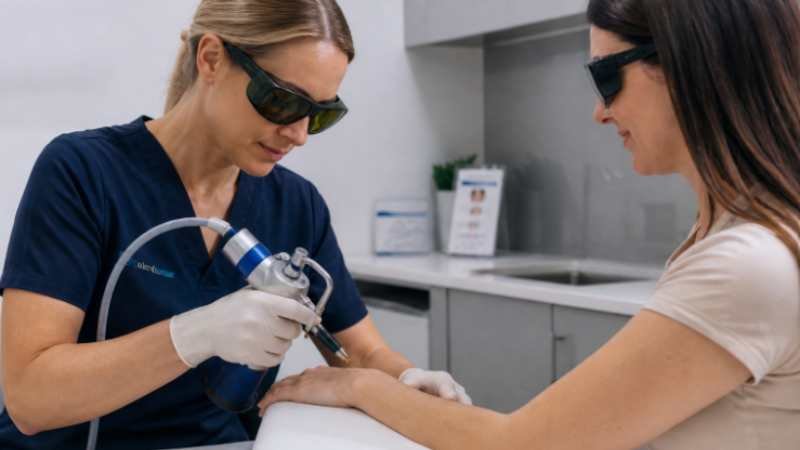
If you’ve ever had a skin spot treated at a doctor’s clinic and been told ‘we’re just going to freeze that off’, you’ve experienced cryotherapy. It’s one of the most common minor procedures in dermatology and general practice and yet most patients have very little idea of what’s actually happening or why doctors choose this approach.
Here’s a clear, straightforward guide to what cryotherapy is, what it treats, and what to expect if you’re having it done.
What Is Cryotherapy in a Medical Context?
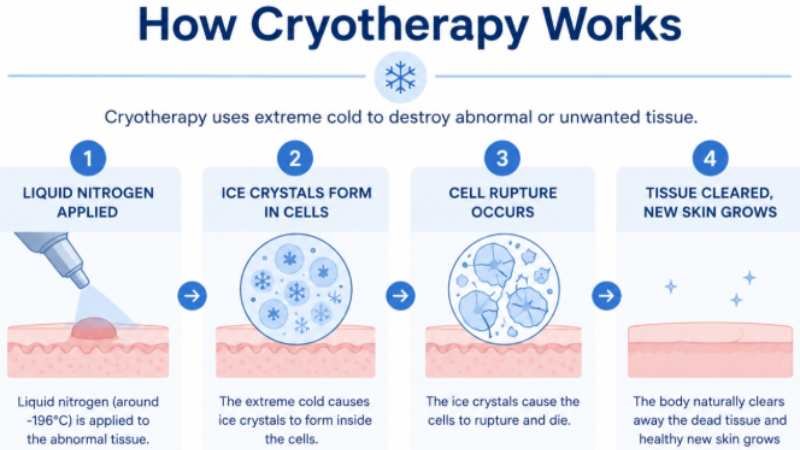
Medical cryotherapy sometimes called cryosurgery uses extreme cold to destroy abnormal or unwanted tissue. In a clinical setting, the most common substance used is liquid nitrogen, which has a temperature of around -196°C. When applied to skin tissue, it freezes the water inside cells, causing them to rupture and die.
The body then gradually clears away the dead tissue, and in most cases, healthy new skin grows back in its place.
This sounds dramatic when you put it that way, but the procedure itself is brief, typically well-tolerated, and has an excellent safety record when performed correctly.
What Skin Conditions Is Cryotherapy Used For?
Cryotherapy is used for a wide range of benign (non-cancerous) and some pre-cancerous skin conditions:
- Seborrhoeic keratoses the waxy, stuck-on looking brown spots that many people develop as they age
- Warts — including common hand warts and plantar warts on the feet
- Solar (actinic) keratoses — rough, scaly patches caused by sun damage that can progress to skin cancer if left untreated
- Molluscum contagiosum — a viral skin infection common in children
- Dermatofibromas — small, firm nodules that appear on the lower legs
- Skin tags — small flaps of skin that often appear in skin folds
Doctors sometimes use it for early squamous cell carcinoma in situ (Bowen’s disease) in appropriate cases, though surgical excision remains the standard treatment for most skin cancers.
What Does the Procedure Feel Like?
Most patients describe the sensation as a sharp cold sting followed by a burning feeling, similar to touching an ice cube for too long. The discomfort usually lasts only as long as the application itself, typically 5 to 30 seconds per spot, depending on the size and depth.
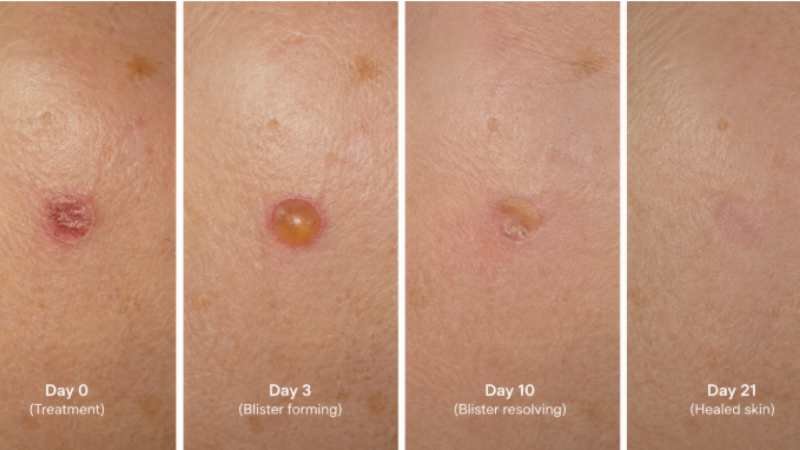
After treatment, the area will feel sore for several hours. Over the next few days, a blister often forms over the treated spot. This is normal and expected it’s part of how the body removes the dead tissue.
The blister should be left to resolve on its own. Most heal within 1 to 3 weeks, depending on the size of the treated area and where it is on the body (areas with good blood supply, like the face, tend to heal faster).
How Precise Is Modern Cryotherapy?
This is where there’s been a meaningful advance in recent years. Traditional cryotherapy used a spray gun that dispersed liquid nitrogen over a relatively wide area. This was effective but imprecise it could affect surrounding healthy tissue, especially on the face or near sensitive areas.
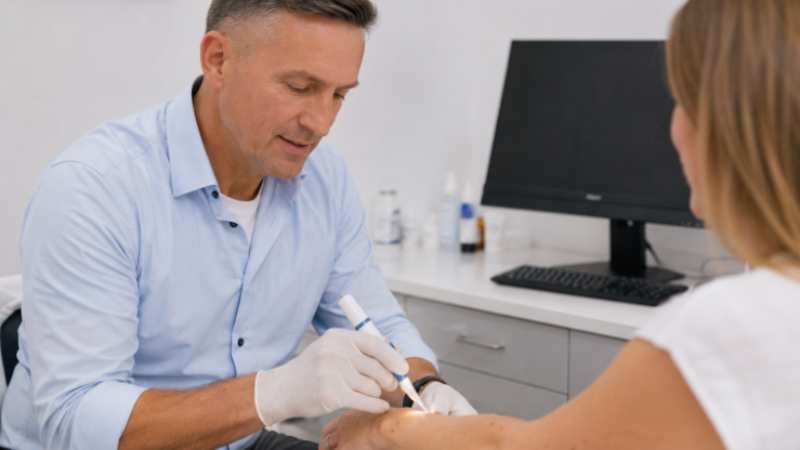
Modern clinics now use precision devices like a medical cryotherapy pen a compact, handheld instrument that delivers a controlled stream of nitrous oxide or CO2 directly onto the target tissue. This allows the clinician to treat a spot as small as 1mm with precision, significantly reducing the risk of affecting surrounding tissue and improving cosmetic outcomes.
Precision cryotherapy pens are particularly valuable for treating lesions on the face, near the eyes, or in other areas where accuracy is critical.
Does Cryotherapy Always Work on the First Treatment?
Not always. The number of treatments required depends on:
- The type and size of the lesion
- How deeply the abnormal tissue extends into the skin
- The location of the lesion
- How well the individual’s immune system responds
Warts, for example, often require multiple sessions, sometimes 3 to 6 treatments spaced 2 to 4 weeks apart because the HPV virus that causes them can survive in tissue surrounding the visible wart.
Solar keratoses and small seborrhoeic keratoses often respond well to a single treatment, particularly when addressed early while the lesion is still superficial.
What Are the Possible Side Effects?
Cryotherapy is generally very safe, but there are some things to be aware of:
- Temporary pain and blistering — expected and part of the healing process
- Hypopigmentation — the treated area may heal lighter than the surrounding skin, particularly in people with darker skin tones. This can be permanent.
- Scarring — uncommon with appropriate technique, but possible, especially if the area is treated aggressively
- Nerve damage — rare, but can cause temporary numbness if the treated area is over a nerve
- Infection — if the blister breaks open and isn’t kept clean
Cryotherapy is generally avoided in people with certain conditions, including cold urticaria (a skin allergy triggered by cold), Raynaud’s phenomenon, or cryoglobulinaemia. Your doctor will screen for these before treatment.
Is It Safe to Have Done at a GP?
Yes provided your GP has appropriate training and equipment. Cryotherapy for benign and pre-cancerous lesions is well within the scope of general practice medicine in Australia, and most GPs perform it routinely.
What matters most is that the doctor properly assesses the lesion before treatment. A doctor should only use cryotherapy once they are confident in the diagnosis. Doctors should not freeze a skin lesion that has not been properly evaluated, particularly if there is any uncertainty about whether it could be skin cancer.
What to Do After Treatment
Your doctor will give you specific aftercare instructions, but general principles include:
- Keep the area clean and dry where possible
- Don’t puncture the blister, let it resolve on its own
- Apply a gentle antiseptic if the skin breaks open
- Avoid sun exposure on the healing area, use SPF 50 once healed
- Return to your doctor if the area isn’t healing as expected or shows signs of infection
Cryotherapy is a well-established, safe, and effective treatment for many common skin conditions. When performed correctly using precision equipment, it delivers good results with minimal downtime for most patients.
If your doctor recommends it for a spot on your skin, it’s a sensible, low-risk option provided the diagnosis is clear and the technique is appropriate.
| Important Note! |
|---|
| Cryotherapy should only be performed by a trained clinician on lesions that have been properly assessed. Never attempt to self-administer liquid nitrogen or commercial freeze sprays on skin lesions, these products are not the same as medical-grade cryotherapy and can cause serious burns. |