
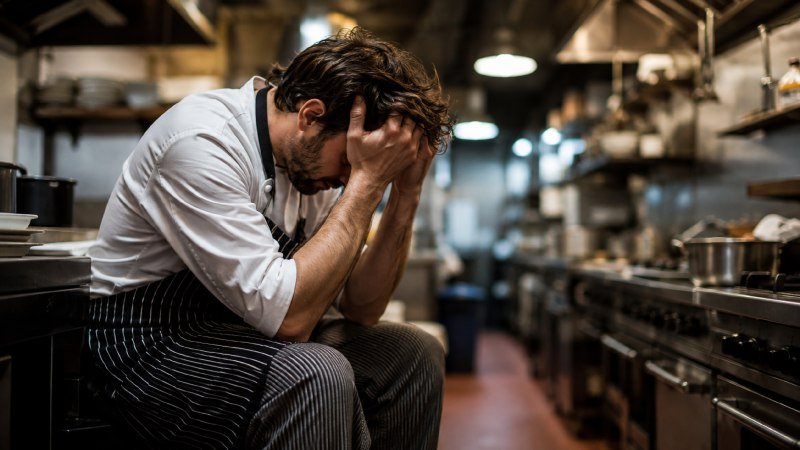
Back of House Burnout: The Mental Health Crisis in Modern Kitchens
The dining room sells control. Plates arrive composed, servers move between restaurant booths, and guests rarely see the sprint that produced their meal. Behind the swinging door, a cook may be working through a ten-hour shift on five hours of sleep. The printer keeps firing. A dishwasher has called out, the new hire needs help, and a delivery arrived late. One mistake can delay an entire station. The cook has not eaten since noon, but stopping feels impossible. By closing time, the body is exhausted while the mind remains locked at service speed.
That gap between public calm and private strain defines much of modern restaurant work. Kitchens combine heat, noise, sharp tools, heavy lifting, compressed deadlines, unpredictable demand, and close physical quarters. Many cooks also face low pay, limited health coverage, changing schedules, and little control over staffing. The pressure can produce pride and camaraderie, but it can also feed chronic stress, sleep disruption, substance use, and emotional withdrawal. The central problem is not that kitchen employees lack resilience. It is that many restaurants still treat preventable harm as proof of commitment.
The term burnout needs careful use. The World Health Organization classifies burnout as an occupational phenomenon rather than a medical condition. It describes three dimensions: exhaustion, growing mental distance or cynicism toward work, and reduced professional efficacy. Burnout may exist alongside depression, anxiety, trauma, or a substance-use disorder, but those conditions are not interchangeable. A manager cannot diagnose them during a lineup, and a wellness poster cannot treat them. Owners can, however, identify harmful job conditions, create routes to professional help, and stop rewarding behavior that pushes workers toward a breaking point.
The Shift Starts Long Before the First Ticket
Kitchen stress often begins with the schedule rather than the dinner rush. A closing cook may leave after midnight, commute home, shower, eat, and still feel physically alert from hours of noise and urgency. If the same employee returns for morning prep, the interval between shifts may provide too little time for sleep. Rotating between opens, closes, doubles, and split shifts makes a stable routine harder. The schedule may change with only a few days’ notice, leaving workers to rearrange childcare, medical appointments, transportation, and second jobs.
Sleep loss affects more than mood. The National Institute for Occupational Safety and Health reports that shift work and long hours disturb sleep and circadian rhythms, reduce recovery time, and contribute to fatigue, negative mood, physical dysfunction, and unsafe behavior. Workers logging at least 48 hours a week have reported more short sleep, poor sleep quality, and insomnia than those working fewer hours. In a kitchen, slower reaction time can mean a sliced finger, a burn, a missed allergen note, or a pan dropped near another employee.
Irregular work also interferes with the body’s timing systems. Cortisol normally follows a daily rhythm, rising around waking and declining later. Research on night work shows that circadian disruption can alter that pattern, although the direction and size of the change vary by schedule, exposure, and individual. It is therefore too simple to say every exhausted cook has “high cortisol.” The sound conclusion is narrower: late, rotating, and extended shifts can disturb sleep and stress regulation, and repeated sleep loss gives the body less opportunity to recover.
Physical conditions add another layer of demand. Cooks stand for hours, reach across hot surfaces, carry stockpots, inhale smoke or cleaning fumes, and work in temperatures that can climb during service. Meals may consist of quick bites taken over a trash can. Water gets postponed because leaving the station requires coverage. Minor injuries are taped and ignored because the team is already short. None of these habits demonstrates professionalism. They show that production has been designed without enough room for ordinary human needs.
Financial insecurity makes recovery even harder. The U.S. Bureau of Labor Statistics reported a median hourly wage of $17.19 for cooks in May 2024, compared with $23.80 across all occupations. A worker living close to the edge may accept every extra shift, delay medical care, or work while sick because a missed day threatens rent. An hourly employee may also hesitate to report panic, depression, or a substance problem if disclosure could cost shifts. The business receives the worker’s labor while the worker carries most of the risk.
When Abuse Becomes a Management Style
Kitchen hierarchy can coordinate complex work, but it can also shield misconduct. The brigade system gives each person a defined role and clear authority during service. That structure helps when twenty orders land at once. Trouble begins when leaders treat rank as permission to humiliate, threaten, or intimidate. Public insults, sexist remarks, slurs, thrown utensils, and deliberate scheduling punishment are not demanding standards. They are management failures that make concentration and honest communication less likely.
Tradition often protects those failures. Some chefs learn under abusive bosses and later repeat the same conduct because they consider it authentic kitchen training. Others frame fear as urgency: if a cook dreads making an error, the cook will supposedly become more precise. Fear produces a different result. Employees conceal mistakes, avoid questions, and stop warning supervisors about risks. A junior cook who expects ridicule may stay silent about an unlabeled container or an allergy concern. The kitchen looks obedient until the hidden problem reaches a guest.
Popular culture has helped turn explosive chefs into entertainment. Shouting can look like passion when edited into a dramatic scene, and an aggressive leader may appear decisive from the dining room. Daily exposure feels different. A cook who absorbs personal attacks for months may become watchful, irritable, numb, or detached. The worker may also carry that behavior forward, snapping at dishwashers and trainees because aggression has become the accepted language of authority.
Power does not fall evenly across a kitchen. Young workers, immigrants, employees with insecure documentation, women, LGBTQ+ staff, and people who need a reference may face higher costs for speaking up. Tipped and hourly workers can lose income through reduced shifts without receiving a formal explanation. A complaint process run by the same manager accused of misconduct offers little protection. A policy has value only when workers know where to report, can do so without retaliation, and see consistent consequences across rank and reputation.
High standards do not require hostility. A chef can identify the error, state the correction, assign responsibility, and follow up after service without attacking the cook’s character. During a rush, instructions should be short and direct. Afterward, coaching should explain what failed in the system as well as what the employee must change. If several skilled workers keep making the same mistake, the cause may be poor labeling, weak training, an overloaded station, or an unrealistic menu rather than a collective lack of discipline.
The After-Service Release Valve
The end of service does not immediately end the body’s stress response. A cook may leave physically depleted but mentally activated, replaying mistakes and hearing the ticket printer in the silence. Alcohol can appear to offer a quick transition from intensity to calm. Stimulants may serve the opposite purpose during long shifts, while cannabis, sedatives, or pain medication may be used for sleep or injury. These choices can begin as occasional coping methods and become harder to control as exposure, tolerance, and stress accumulate.
Industry data justify concern without proving that restaurant culture alone causes addiction. A federal analysis using 2008–2012 survey data found that full-time workers in accommodation and food services had the highest reported rate of past-year substance-use disorder among the industries studied, at 16.9 percent. The difference did not remain after researchers adjusted for age and gender, an important limitation. The older data should not be treated as a current head count, but they show why owners should take prevention and treatment access seriously rather than relying on stereotypes.
Workplace customs can make risky use harder to recognize. The shift drink may function as team bonding, and employees who decline can feel excluded. Alcohol is also readily available in many restaurants, while cash tips and late hours can support an after-work bar routine. Substance use may be hidden because the employee continues to perform. A cook can arrive on time, execute a station, and still be struggling. Waiting for a dramatic collapse misses the long period when confidential help might be most useful.
Shame blocks help from both directions. Workers may fear being labeled unreliable, while managers may avoid the subject because they feel unqualified or worry about legal exposure. A supervisor should not act as a therapist or demand personal details. The appropriate role is to notice work-related changes, speak privately about observable behavior, explain available resources, and address immediate safety concerns. A person who discloses a problem needs a route to care, not an improvised lecture or a public confrontation.
Recovery-supportive policies can protect people and operations. Restaurants can provide confidential employee-assistance options, publish treatment contacts, allow time for appointments, and train managers to respond to impairment consistently. They can make social events less centered on alcohol and offer appealing nonalcoholic drinks without comment. They can also distinguish accountability from punishment: unsafe conduct requires action, but a worker seeking treatment should not automatically be treated as morally defective.
Harm reduction offers practical steps before a worker enters formal treatment. Managers can train staff to recognize an overdose, keep naloxone where permitted, and explain local Good Samaritan protections without assuming who may need them. They can replace the unwritten rule of driving home after a shift drink with a clear transportation policy. They can also prohibit supervisors from buying alcohol for employees as a reward for surviving a difficult service. These measures do not approve unsafe substance use. They recognize that secrecy raises risk and that a restaurant should prepare for foreseeable emergencies just as it prepares for burns, cuts, and fires.
When the Body and the Business Start Failing Together
Burnout usually announces itself through patterns rather than a single event. A reliable cook begins arriving late, forgets familiar prep, reacts sharply to small requests, or stops speaking during family meals. Another worker develops headaches, stomach problems, dread before shifts, or persistent trouble sleeping. These signs do not establish a diagnosis, and they may have causes outside work. They do signal that a private check-in and a review of workload are warranted.
Operational damage often appears beside personal distress. Fatigued employees communicate less clearly, work more slowly, and have less attention available for safety checks. Cynical workers stop suggesting improvements because they no longer believe management will listen. Strong employees leave, forcing the remaining crew to train replacements while covering empty positions. The resulting overload produces more mistakes and more departures. What looks like an attitude problem may be a staffing and scheduling loop created by the business itself.
Turnover also hides costs that do not appear on a resignation form. Managers spend time recruiting, interviewing, onboarding, and correcting early errors. Food waste increases while a new cook learns portioning and timing. Regular guests notice inconsistency. Overtime rises. Team members lose trust when management repeatedly asks them to “push through” vacancies. A restaurant can save money by running lean for several weeks, then lose those savings through months of instability.
Family life absorbs the strain as well. Restaurant employees often work when partners, children, and friends are free: evenings, weekends, and holidays. An unpredictable rota makes plans fragile, while chronic exhaustion leaves little energy for relationships on days off. NIOSH identifies reduced time for family and nonwork responsibilities as one pathway through which long hours cause harm. A job does not need to follow a nine-to-five schedule, but workers still need dependable time in which they are not on call, recovering from a close, or waiting for the next rota.
Wellness Programs That Reach the Line
Industry-specific support has grown because ordinary services often miss the realities of hospitality work. The Southern Smoke Foundation’s Behind You program connects food and beverage workers with no-cost counseling in participating states. Culinary Hospitality Outreach and Wellness, known as CHOW, runs peer discussion meetings, mental health education, and suicide- and overdose-prevention training. Not 9 to 5 offers hospitality-focused education through its CNECTing platform and CNECTed certification. These programs use industry language and recognize that workers may need help outside conventional office hours.
Peer support can reduce isolation, but it should complement clinical care rather than replace it. A coworker may be the first person to hear that someone is struggling, yet that coworker should not carry responsibility for treatment or crisis management. Restaurants need clear escalation steps, current crisis contacts, and trained managers. In the United States, a person in suicidal crisis or severe emotional distress can call or text 988. Immediate danger still requires emergency services. Posting those details in an employee area gives staff access without forcing a public request.
Leadership training addresses another part of the problem. The #FairKitchens movement and the Culinary Institute of America developed free training aimed at healthier kitchen leadership and staff retention. The useful lesson is not a branded checklist; it is the recognition that chefs are managers. Technical skill with food does not automatically provide skill in feedback, conflict, scheduling, harassment prevention, or mental health response. Restaurants routinely train people on knife cuts and plating specifications. Training the same leaders to manage humans deserves equal seriousness.
Weak wellness programs focus on individual coping while leaving the job unchanged. A meditation subscription cannot repair a rota that schedules repeated close-open turnarounds. A resilience workshop cannot compensate for understaffing, wage theft, harassment, or a chef who throws pans. Free fruit in the break area means little if no one can take a break. Workers notice when wellness language becomes a way to transfer responsibility from the company to the person being harmed.
Strong programs change daily operations. Managers publish schedules earlier, limit consecutive long shifts, track actual hours, protect meal and water breaks, and avoid contacting workers during rest time except for genuine emergencies. They provide paid sick time where possible, cross-train stations so one absence does not trigger a crisis, and schedule enough people for predictable peaks. They also review menu complexity, reservation pacing, prep systems, and closing duties. Mental health policy belongs in labor planning, not only in an employee handbook.
Staff participation makes those changes more credible. A restaurant can form a small paid committee with representatives from prep, dish, pastry, the line, and front of house, then give it authority to review schedules and recurring stress points. Meetings should occur on paid time, with notes and assigned actions. The group might discover that Sunday brunch fails because deliveries arrive during prep, or that one closing checklist keeps cooks an hour later than managers realize. Listening sessions without decisions create more frustration. A useful process names the problem, identifies an owner, sets a date, and reports what changed.
Building a Kitchen People Can Stay In
Owners can begin by measuring what the kitchen currently normalizes. Weekly reviews should include total hours, overtime, missed breaks, last-minute schedule changes, injuries, callouts, and turnover by manager or shift. Anonymous staff surveys can ask whether employees feel safe reporting errors, harassment, fatigue, or impairment. Exit interviews should look for repeated causes rather than filing each departure as a personal mismatch. Data will not capture every problem, but it can expose patterns that charisma and busy service conceal.
Managers can also create a simple response protocol. When a worker appears overwhelmed, the supervisor should move the conversation away from the line, describe specific observations, ask what immediate support is needed, and discuss workload or time off. The supervisor should share professional resources without demanding disclosure. If safety is at risk, the manager must remove the person from hazardous work and arrange safe transportation when necessary. The same core process should apply regardless of whether the employee is a dishwasher, executive chef, or celebrated hire.
Workers need boundaries they can use without punishment. A protected break, a genuine day off, and the right to raise a safety issue should not depend on being the chef’s favorite. Written rules matter, but leaders establish the real standard through their reactions. If the chef mocks the first person who uses a mental health day, the policy ends there. If ownership quietly restores shifts to an accused harasser, the reporting system loses credibility. Consistency turns policy into working culture.
Diners also occupy a small place in the system. Guests need not investigate every kitchen before ordering, but they can reject the idea that abuse produces better food. They can treat delays with proportion, respect closing times, and support restaurants that discuss fair scheduling, paid leave, and staff development with specifics. Low menu prices and constant availability carry labor consequences. Consumer behavior cannot repair employment practices, but it can stop rewarding some of their worst expressions.
Modern kitchens do not have to become quiet or easy to become humane. Service will still demand speed, preparation, judgment, and accountability. The change lies in separating useful pressure from avoidable damage. A disciplined kitchen plans for recovery, corrects without humiliation, and treats requests for help as information rather than weakness. The industry asks cooks to care about every plate that leaves the pass. Restaurant leaders must bring the same attention to the people who make those plates possible.


