
Nodules, Polyps and Paralysis: How Doctors Decide Whether You Actually Need Vocal Cord Surgery
If your voice has been rough for a few weeks and someone has mentioned an operation, your first instinct is probably to search for the operation. That is the wrong end of the problem to start from.
The single most useful thing to understand about your larynx is that half a dozen very different conditions produce almost identical symptoms. Hoarseness, a voice that tires by lunchtime, a pitch that keeps breaking, the sense that you are pushing air through a gap — all of those can come from a callus, a fluid-filled blister, a stretched nerve, a smoking-related swelling, or something that needs a biopsy. Some of those respond beautifully to a few months of therapy. Some will not improve no matter how much you rest. And one of them you want found early.
So this article works the way a good laryngologist works: diagnosis first, decision second, operation last.
General information only, not medical advice. Only a specialist who has looked at your vocal folds can tell you what applies to you.
What Is Actually Going Wrong In There
Your vocal folds are two layers of remarkably delicate tissue that slam together and peel apart somewhere between 100 and 250 times a second when you speak. They have a soft, gel-like layer just beneath the surface that lets them ripple. That layer is the whole ballgame. Anything that stiffens it, adds mass to it, or stops the two folds meeting cleanly will change your voice.
That gives you three broad failure modes:
- Something is sitting on the fold — a nodule, polyp, cyst or swelling adds mass and blocks closure
- The fold cannot move properly — nerve injury, or scarring that has stiffened the tissue
- Something is growing that should not be there — from benign papillomas through to pre-cancerous change
The treatment path forks sharply depending on which of those you have.
The Diagnoses That Lead to Surgery Most Often
Nodules — usually not a surgical problem
Vocal nodules are the ones people have heard of, and they are the ones least likely to need an operation. They form symmetrically on both folds, like calluses, from sustained overuse and misuse — teaching, coaching, bar work, call centres, singing without technique, or simply talking loudly for a living.
Because they are caused by mechanics, they usually respond to changing the mechanics. Voice therapy with a speech and language pathologist is first-line treatment, and a properly delivered course over three to six months resolves a large proportion of cases outright. Surgery enters the picture only when nodules have become fibrous and stopped responding, and even then it is followed by therapy, because removing the callus without fixing the behaviour that built it invites it straight back.
If someone offers to operate on freshly diagnosed nodules before you have tried therapy, get a second opinion.
Polyps and cysts — often genuinely surgical
A polyp is typically one-sided and often traces back to a single event: a heavy bleed into the fold during a shouting match, a concert, an illness. A cyst sits within the fold rather than on it, often congenital, and it stiffens the vibrating layer.
These behave differently from nodules. Therapy can improve how efficiently you use the voice around them, but it rarely removes them, and a cyst in particular tends to sit there indefinitely. Microsurgical removal is a reasonable and well-established option.
Reinke’s oedema — the smoker’s voice
A soft, floppy swelling along both folds, strongly associated with smoking, which drops the pitch of the voice noticeably. Surgery can reduce it, but it will recur if smoking continues, so most surgeons will require you to stop first. That is not gatekeeping; it is arithmetic.
Vocal fold paralysis — where timing matters
If a nerve to the larynx has been injured — after thyroid, neck, chest or spinal surgery, after a difficult intubation, after a virus, or with no identifiable cause at all — one fold may stop moving. You get a breathy, weak voice, you run out of air mid-sentence, and liquids may go down the wrong way.
The important nuance is that many of these recover on their own within six to twelve months. So the standard sequence is: assess, protect your swallowing, and often place a temporary injection to bulk out the fold while you wait. Permanent procedures such as medialization thyroplasty or nerve reinnervation are generally reserved for when spontaneous recovery has not arrived. Rushing to a permanent implant in month two can mean operating on a problem that was going to fix itself.
Scar, and the things nobody promises to fix
Scarred or grooved folds are the hardest category in this field. Once that soft vibrating layer has been replaced by stiff tissue — through injury, through previous surgery, through repeated procedures — restoring normal vibration is genuinely difficult. Reputable surgeons say so plainly. Be wary of anyone who does not.
Why Your First Appointment Should Involve a Camera
Here is the part people skip, and it is the part that determines whether everything downstream is sensible or guesswork.
You cannot diagnose a voice by listening to it. A nodule and a cyst can sound the same. Early cancerous change can sound like laryngitis. The examination that matters is a laryngoscopy — a thin flexible camera passed through the nose, which is far more comfortable than it sounds — and ideally videostroboscopy, which uses a strobing light to show the folds vibrating in slow motion. Stroboscopy is what reveals whether the soft layer is moving normally, which is the difference between “there is a lump” and “we know what the lump is doing.”
Any surgical plan made without looking at your folds this way is a plan built on assumption.
Get seen promptly rather than waiting if you have hoarseness lasting more than three weeks, a lump in your neck, pain on swallowing or a sense of something stuck, coughing up blood, unexplained ear pain, or any change in your breathing — and particularly if you smoke or drink heavily. In the large majority of cases the answer is benign and reassuring. The point of going early is that the small minority of cases are the ones where early matters enormously.
What Happens on the Day
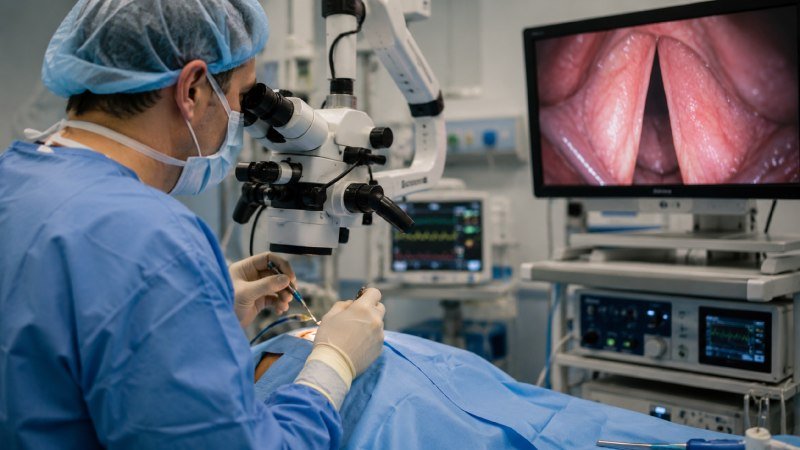
For most fold lesions, the procedure is a microlaryngoscopy. Under general anaesthesia, the surgeon passes a rigid scope through your mouth, works down a microscope with instruments finer than a matchstick, and removes the lesion while preserving as much healthy tissue as possible. It typically takes under an hour, there is no external incision, and most people go home the same day with a sore throat and a slightly bruised feeling.
For paralysis, the approach differs: an injection can often be done under local anaesthetic in clinic, while a thyroplasty involves a small incision in the neck, sometimes with you awake so your voice can be tested as the implant is positioned.
Afterwards, expect a period of strict voice rest, a stretch of weeks where your voice sounds worse than before, and a genuine result that only settles at around three to six months. Judging the outcome early is judging swelling.
What This Kind of Surgery Can and Cannot Do
It can remove mass, restore fold closure, and give you back a voice that lasts a full working day. What it cannot do is change how you use your voice, guarantee your former singing range, reverse established scarring, or prevent a recurrence when the underlying cause — shouting over noise, reflux left untreated, smoking — is still in place.
This is why the outcome data consistently favours the same combination: correct diagnosis, appropriately timed vocal cord surgery, and voice therapy on both sides of it.
If You Are Weighing Up Clinics, Including Abroad
Laryngology is a genuinely specialised field, and access to it varies wildly by country. Plenty of people travel, and Turkey is among the more common destinations for laryngeal work.
Wherever you go, the variable that predicts your result is not the location or the price. It is how many of your specific procedure that surgeon performs, and whether they can prove it. Ask for annual case numbers, ask to see pre- and post-operative stroboscopy rather than just audio, ask who provides your voice therapy and in what language, and get the revision policy in writing. If you are comparing specialist clinics in Turkey against options at home, run both through exactly the same six questions and see which answers arrive in writing.
One more: ask what they would do if the scope shows something they were not expecting. A surgeon with a clear answer to that has thought about your case rather than their calendar.
The Short Version
Vocal cord surgery is a precise, effective intervention for a fairly narrow set of problems — and an unnecessary one for several conditions that look identical from the outside. The order of operations protects you: get scoped, get a named diagnosis, try therapy where therapy is the evidence-based first move, and reserve the operating theatre for the cases that genuinely need it.
Three weeks of hoarseness is worth an appointment. It is almost never something frightening. It is also not something to keep clearing your throat and hoping about.