
Why Health Systems Are Moving Care Home: The Financial and Clinical Case for Connected Chronic Care
Chronic disease is the largest driver of healthcare spending in most developed countries. Hypertension, diabetes, heart failure, and COPD account for a large share of hospital admissions, emergency visits, and long-term costs. For decades, the care model for these conditions has been episodic: a patient visits a clinic every few months, gets a snapshot of their health, and returns to life until something goes wrong.
That model is changing. Health systems, clinics, and payers are shifting toward continuous, home-based care, where devices and software track a patient’s health between appointments. The question for most leaders is no longer whether connected care works clinically, but whether it makes financial sense to run at scale. This article looks at both sides and offers a practical framework for evaluating a program before and after launch.
The Problem With Episodic Care
A typical patient with congestive heart failure might see a cardiologist every three months. In between, their weight can climb, their blood pressure can drift, and early warning signs can go unnoticed. By the time symptoms are obvious enough to prompt a call, the patient is often in the emergency department.
Episodic care has three structural weaknesses:
- Late detection. Problems are found at the point of crisis rather than at the point of change.
- Fragmented data. A single clinic reading says little about how a patient is doing day to day.
- Reactive workflows. Care teams spend their time on urgent cases instead of preventing them.
These weaknesses are expensive. Avoidable admissions and readmissions strain hospital capacity, and in value-based contracts they can also reduce reimbursement. Patients feel the cost too, in lost work, stress, and worsening health.
What Connected Chronic Care Looks Like in Practice
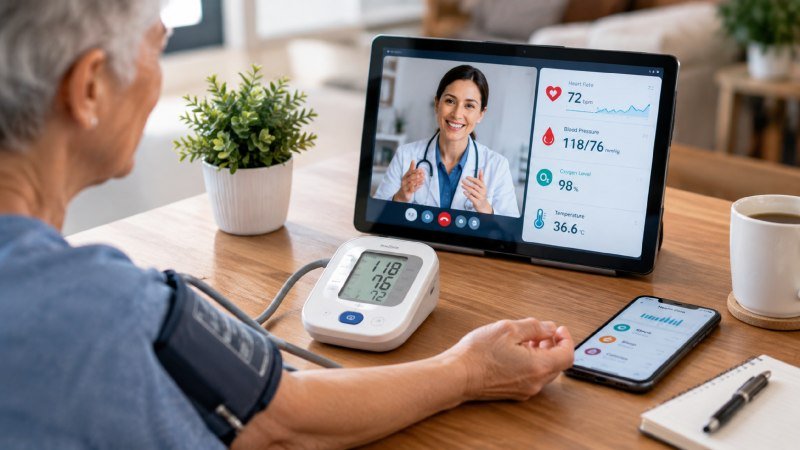
Connected care programs give patients simple devices such as blood pressure cuffs, glucometers, pulse oximeters, weight scales, or wearables. Readings transmit automatically to a clinical dashboard. Software flags values outside agreed thresholds, and a nurse or care coordinator follows up by phone, message, or video.
The strength of the model is the combination of data and human attention. A single elevated reading rarely matters. A pattern of rising readings over five days does, and a care team that sees it can adjust a medication, schedule a visit, or simply check in before the situation escalates.
Programs typically follow a similar arc:
- Enrollment. Eligible patients are identified from existing records and invited to join.
- Onboarding. Devices are shipped or handed out, and patients are shown how to use them.
- Monitoring. Readings flow in daily or several times a week.
- Intervention. Clinicians act on alerts and trends.
- Review. Outcomes and engagement are reviewed regularly and thresholds are refined.
The Clinical Benefits Leaders Should Expect
Before turning to finances, it helps to be clear about the clinical gains, since they drive nearly every financial outcome.
Better control of chronic conditions. Frequent measurements give clinicians a fuller picture. Blood pressure, glucose, and weight can be managed against trends rather than one-off readings, which supports more precise treatment adjustments.
Earlier intervention. Catching deterioration days or weeks sooner often means a phone call and a medication change instead of an ambulance ride.
Stronger patient engagement. Patients who see their own numbers tend to take a more active role in their care. Regular contact with a care team also builds trust and accountability.
Reduced clinician burden on routine tasks. When monitoring is structured, clinicians can concentrate on the patients who need attention most instead of working through uniform schedules.
None of these benefits is automatic. They depend on patient selection, workflow design, and how consistently the care team responds to data. Programs that treat the technology as the whole solution tend to disappoint. Programs that treat it as a tool inside a well-designed care process tend to succeed.
Where the Financial Value Comes From
Executives often ask where the savings actually appear. In practice, value comes from several streams, and a credible business case should account for each of them separately.
Avoided acute utilization
The most visible driver is fewer emergency visits, hospital admissions, and readmissions. Even modest reductions in these events can be significant, because a single admission costs far more than months of monitoring for the same patient.
Reimbursement and revenue
In many markets, payers reimburse providers for setup, device supply, and time spent managing patients remotely. Where such codes or programs exist, they can offset a meaningful share of program costs. Leaders should confirm current billing rules and documentation requirements in their own region, since these vary and change.
Quality and value-based performance
Better-controlled chronic conditions improve quality measures. Under value-based and shared-savings contracts, stronger performance can translate into bonuses or avoided penalties.
Capacity and efficiency
Fewer avoidable visits free up appointment slots and bed days. For organizations facing long waits or capacity limits, this is real financial value, even if it does not appear as a line-item saving.
Retention and loyalty
Patients who feel supported between visits are more likely to stay with a provider. Over time, retention supports both revenue stability and continuity of care.
The Costs You Need to Count Honestly
A fair evaluation includes the full cost side, not only the device price. Typical cost categories include:
- Devices, replacement, and logistics
- Software platform and integration with existing records
- Clinical staffing for monitoring and outreach
- Patient onboarding and technical support
- Training, compliance, and data security
- Program management and reporting
Staffing is often the largest and most underestimated cost. A program that enrolls hundreds of patients without enough clinicians to respond to alerts will create risk rather than reduce it. Sizing the care team correctly from the beginning is one of the most important decisions in program design.
A Practical Framework for Measuring Return
Measuring return on a connected care program is harder than it looks, because many benefits are events that did not happen. The following approach keeps the analysis grounded.
Step 1: Define a baseline. Before launch, record utilization, costs, and clinical measures for the target population over a meaningful period, such as the previous 12 months.
Step 2: Choose a comparison. Where possible, compare enrolled patients with a similar group who are not enrolled, or compare each patient against their own history. Without a comparison, it is easy to credit the program for changes that would have happened anyway.
Step 3: Track a balanced set of metrics. Combine financial measures (cost per patient, avoided admissions, net program cost) with clinical measures (blood pressure control, HbA1c, symptom scores) and experience measures (engagement, satisfaction, retention in the program).
Step 4: Separate short-term and long-term effects. Some benefits appear within months, while others, such as slower disease progression, take years. Reporting them separately avoids overpromising early.
Step 5: Review and adjust. Use the data to refine patient selection, alert thresholds, and staffing levels. Programs improve most when leaders treat the first year as a learning period.
For a deeper look at how to calculate and present these figures, this guide to remote patient monitoring roi walks through the key inputs and how organizations can think about returns in practical terms.
Choosing the Right Patients
Not every patient benefits equally. Programs usually perform best when they focus on people with a high likelihood of avoidable events and a realistic ability to engage. Common starting groups include:
- Patients with recent hospital discharges for heart failure or COPD
- Adults with uncontrolled hypertension or diabetes
- Patients with multiple chronic conditions
- Individuals recovering from surgery who need close follow-up
Equally important is choosing patients who can and will use the devices. Simple setup, clear instructions, and responsive support lower drop-off rates. For patients with limited digital confidence or connectivity, additional help or alternative devices may be necessary to avoid widening gaps in access.
Common Reasons Programs Underperform
Many connected care programs fall short for predictable reasons. Knowing them in advance makes them easier to avoid.
Alert overload. Thresholds set too tight generate noise, and clinicians begin to ignore alerts. Calibrating thresholds to each patient reduces fatigue.
Poor integration. If monitoring data sits in a separate system, clinicians have to switch screens to use it, and adoption suffers. Integration with the existing record is worth the effort.
Low patient adherence. Patients stop transmitting readings when devices are confusing or when no one seems to respond. Regular outreach keeps engagement up.
Unclear ownership. When it is unclear who reviews data and who acts on it, alerts fall through the cracks. Defined roles and escalation paths are essential.
Premature judgment. Evaluating results after only a few weeks can mislead. Most programs need several months to show a stable pattern.
Looking Ahead
Connected chronic care is moving from pilot projects to core infrastructure. Advances in sensors, analytics, and interoperability are making programs easier to run and easier to scale. At the same time, payers and policymakers are paying closer attention to evidence, which means organizations that measure carefully will be better placed to secure support.
The organizations that benefit most will likely be those that approach the work with discipline: clear goals, the right patients, adequate clinical staffing, and honest measurement. When these elements are in place, the shift from episodic to continuous care can improve outcomes for patients while giving health systems a sustainable financial footing. For leaders building their own case, a clear view of remote patient monitoring roi is a useful starting point, since it connects clinical activity to the financial results that boards and finance teams care about. You can explore that perspective further through this resource on remote patient monitoring roi.
Final Thoughts
Moving care into the home is not simply a technology upgrade. It is a change in how clinicians, patients, and organizations relate to chronic illness: from reacting to crises to preventing them. The financial case rests on avoided acute care, better quality performance, and more efficient use of clinical capacity, balanced against real costs for staffing, devices, and integration. Leaders who measure honestly, start with the right patients, and refine as they learn are most likely to build programs that last.