
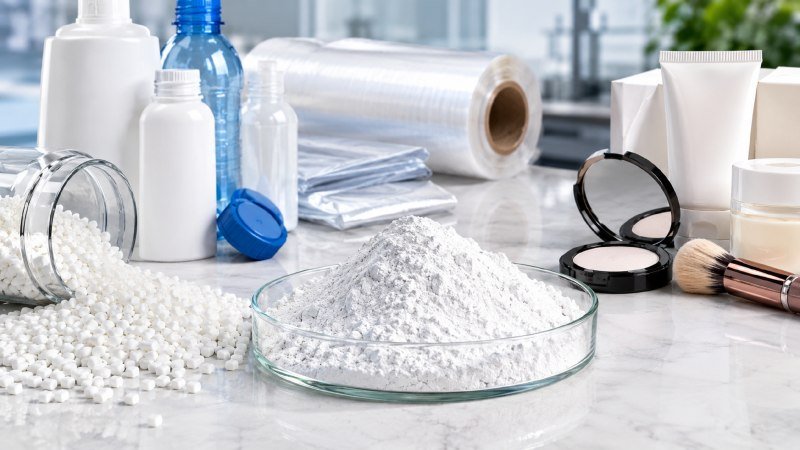
Titanium Dioxide: Applications in Chemical Engineering, Plastics, Packaging, and Cosmetics
Titanium dioxide (TiO₂) is a significant inorganic compound that has a wide application range in the manufacture of various products due to its perfect whiteness, opacity, brightness and light scattering properties. Its wide-ranging versatility is applied in plastic packaging, industrial applications and cosmetic formulations, among others, helping manufacturers meet specific appearance and performance requirements. It is also a useful chemical in various industrial applications, thanks to its stability and availability in various grades.
Knowledge of the properties of titanium dioxide is vital for the chemical engineer, product developer and producer in charge of raw material choice, production efficiency and product quality control. Right grade is based on the application, processing conditions and specification.
So, what is Titanium Dioxide?
Titanium dioxide (TiO₂) is a natural resource found in minerals and also is commercially manufactured and processed for various uses. It can be used to scatter visible light to good effect, and has a strong whitening effect which is often used as a white pigment.
There are two different crystalline forms of the commercial TiO2 — rutile and anatase. Even though both are made of TiO₂, the physical property and the performance of both differ from each other.
Typically, rutile has a higher refractive index, and is used more frequently when opacity, durability, and weather resistance are important factors in application. It is widely used for exterior coatings, plastics and other specialty industrial products.
Anatase is used for its high whiteness and tinting properties and is used in selected applications such as paper, textiles and some industry formulations. Some of the forms are suitable for particular product needs rather than solely colour and price.
In addition to the aforementioned properties, complementarily should be taken into account, particle size, surface treatment, purity, dispersion property and compatibility with the final formulation of titanium dioxide selected by the manufacturer.
Key Applications in Chemical Engineering
Chemical process design and optimization is a component of chemical engineering that seeks to convert raw materials into valuable products. Titanium dioxide plays a role in this work which sets a boundary condition of the application of this functional pigment, whose performance is determined by the process conditions, materials and formulation.
In industrial production, engineers assess the behavior of TiO₂ in various industrial processes, such as mixing and dispersion, heating and extrusion processes, etc. Lack of dispersion can result in uneven colour, particulates that are visible and different quality product. After investigating these, a suitable grade must be selected and processing parameters controlled to minimise these.
There are also other rare uses outside of pigment use of titanium dioxide such as in specific photocatalytic and surface-treatment applications. But these are only applicable if proper grades and carefully controlled conditions are used, as the activity of the photocatalytic effect may be what is not needed in products, such as those where polymer stability is important.
For manufacturers, the challenge is to choose a material with the appropriate optical properties, undisturbed by the manufacturing process and the operating conditions.
Titanium Dioxide in Plastics Manufacturing
Titanium dioxide is used in a wide variety of ways, one of which is in the plastics industry. is used in polymers for whiteness, opacity and visual uniformity for endproducts.
Typical uses are with polyethylene (PE), polypropylene (PP), polyvinyl chloride (PVC), engineering plastics, plastic film, pipes, profiles and colour masterbatches.
Titanium dioxide gas application in white masterbatch process includes the concentration (concentration in a carrier resin) of TiO2 and later mixing it into polymer during the production process. Thus it can be used by processors to control the amount of pigment used and ensure consistent colour in batches of production.
The choice of grade may have a large impact on the processing performance. The dispersion results in preventative agglomeration, streaking and unwanted surface defects. Thermal stability is also a requirement since the plastics can be subjected to high temperatures during their production, such as in extrusion or injection moulding or film making.
Rutile grades are also used for outdoor plastic applications like window profiles, garden furniture, construction materials, etc., due to their optical effectiveness and durability under various environmental conditions. Surface treatment can further enhance surface compatibility and durability depending on the need.
Titanium dioxide by itself doesn’t instantly impart all the mechanical attributes of a plastic, though. Changing the pigment load and/or particle size, the particular polymer (or chemistry) and ultimately the formulation can change its influence on strength, flexibility and processing behaviour.
The Function of Titanium Dioxide in Packaging Material
Titanium dioxide is also the material used in package manufacturing to enhance the visual look, visual uniformity and opacity of products. It is very useful for plastic containers, bottles, caps, films and other parts of packaging applications in which high transparency in the transmittance mode or effective light shielding is wanted.
TiO₂ can be added to polyethylene or polypropylene to give the flexible packaging the desired whiteness and opacity. For rigid packaging, it can be utilized to give an attractive and uniform, packaged finish in containers that are used in both consumer and industrial products markets.
Light protection is another key factor to take into account. Some titanium dioxide formulations can help diminish light transmission properties of packaging material. This can be advantageous in packaging for products which suffer from degradation under light exposure, but to what degree depends on the amount of pigment in the product, the thickness of the film and the structure of the packaging.
Titanium dioxide suitable for packaging should be considered based on several factors:
– Opaque and whitish: No excessive loading of the pigment should be seen in order to obtain the desired appearance.
Uniform Distribution – Dispersion to minimize streaks, spots and defects in the finished films.
Processing compatibility: The grade must be able to be extruded or moulded at the temperature/s and shear level/levels necessary for the process.
The regulatory requirements are: The packaging materials and its intended use must meet the applicable regulations regarding the finished product.
All such considerations help companies involved in packaging balance the needs and requirements of the product that they package it, as well as the production efficiency.
Titanium Dioxide in Cosmetics and Personal Care
You’ve also made titanium dioxide common ingredients in cosmetic and personal care preparations. It will act as a white pigment, as an opacifying agent, or as an ingredient for filters against UVA and UVB to add to various products like foundations, face powders, creams and sun preparations, depending on its grade and its respective particle properties.
In foundations and concealers, titanium dioxide provides coverage and helps to provide uniform color. When used in face powders and other coloured cosmetics, it can help to maintain brightness and opacity while also contributing to the color and texture.
Special grades are incorporated into the sun protection cream to disperse and block the harmful UV radiations. It determines the efficiency of the final product, where particle size and surface treatment, dispersion, formulation designs are important. The cosmetic manufacturer needs to assess these parameters to provide these everyone needs to achieve the necessary protection, stability and sensory properties.
Not all the industrial grade Titanium Dioxide is recommended for cosmetic application. Materials with property specification requirements for purity, quality and regulation are needed for personal care products. There is a need for manufacturers to get appropriate technical documentation and confirming compliance with applicable regulations for their intended markets.
Specific nanomaterial requirements can also be required for certain product types and formulation. For this reason, cosmetic developers have to test the particular grade and application they intend to utilize instead of taking any of the titanium dioxide products for granted.
How to Choose the Right Titanium Dioxide Supplier
One of the manufacturing quality control processes is to find a dependable anatase TiO2 supplier. The performance of the titanium dioxide in the finished product may vary from one batch to another as well as due to their temperature of treatment and their purity.
Here are a few points to consider when assessing a supplier.
Product specifications: Check the technical data sheet to ensure that the product specification is suitable for the application. Some of the parameters of paramount importance can be, for example TiO₂ content and crystal form, particle characteristics and surface treatment.
Consistency of quality: Ask for COA’s for historical batches and define appropriate incoming material tolerances.
Technical support: A knowledgeable supplier should be able to describe the various grades available and provide information on which grade are appropriate to a specific manufacturing process.
Application suitability: Ensure that the product is suitable for the application to be used, particularly for food contact packaging or cosmetics.
Supply reliability: Assess the packaging choices available, minimum orders, delivery periods and the supplier’s support capability for continued production.
Tio2manufacturer.com is a website that allows businesses to find information about titanium dioxide products and the different grades available. Technical specifications comparisons and confirmation of suitability of intended process can assist buyers in making informed purchasing decisions.
Best Practices for Handling and Processing Titanium Dioxide
Appropriate handling and processing are critical to product quality and to safeguard workers. Titanium dioxide is set to have a wide application area, but airborne dust during the process of powder processing needs to be controlled.
Manufacturing sites need to adhere to relevant Safety Data Sheet, maintain proper extract and dust collection equipments and offer suitable personal protective equipments if necessary. In addition to following the above procedures, workers should adhere to existing standard practices for storage, transfer, mixing, and cleaning.
Effective dispersion is especially crucial during production. The manufacturers can apply using proper mixing equipment, dispersing agent or masterbatch system for suitable uniform distribution of pigments. The optimum method is dependent upon the polymer or formulation, equipment design and the final properties required.
It is important for quality-control to inspect the materials received, check the processing environment and the quality of the products produced for colour consistency, opacity, and any visible defects. The following steps can be used to reduce waste, enable the efficient production of goods and ensure consistent production.
Conclusion
Nature and versatility of its optical properties make titanium dioxide one of the most important chemical engineering materials, plastics and plastics industries, packaging and cosmetics. It can be used to help manufacturers get whiteness, opacity, brightness and in appropriate formulations, light degradation resistance.
But using the white pigment is not enough to make successful application. The abilities of the final product are affected by the crystal structure, the particle size, surface treatment of the particles, the dispersion, processing conditions, workers’ safety, and regulatory compliance requirements.
If a manufacturer can consider these factors and has good technical information from a supplier, it will be possible to choose a grade of titanium dioxide that is suitable for the production needs. Please check tio2manufacturer.com for more detailed product information and applications.