
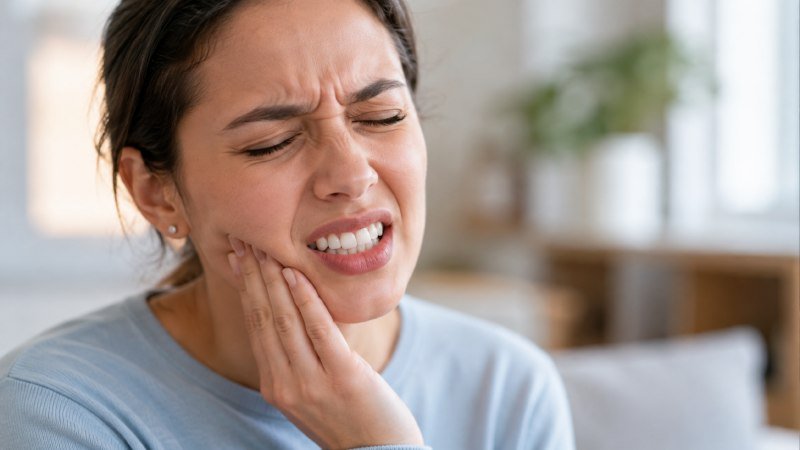
Biting Down Hurts: Here Is What That Pain Is Actually Telling You About Your Teeth
Before we get into the causes, let’s get specific about what you are actually feeling, because the sensation itself is one of the most useful diagnostic clues available.
Is it a sharp, stabbing pain that hits when you release the bite rather than when you press down? That specific pattern, pain on release rather than on contact, is the textbook presentation of a hairline crack in the tooth. Is it a constant, throbbing pressure that does not go away between bites and keeps getting worse? That points toward an infection or abscess, where bacteria have reached the pulp, the nerve center of the tooth, and the surrounding tissue is inflamed. Or is it more of a widespread, dull soreness that is worst in the morning, affecting multiple teeth at once? That is the signature of bruxism, the clinical term for grinding or clenching your teeth during sleep.
Each of these sensations points to a different underlying cause. Understanding which one you are dealing with is the starting point for getting the right treatment rather than waiting for something that will not resolve on its own.
Key Takeaways
- Pain on biting down has several distinct causes, and the character of the pain gives important clues about which one is present.
- Hairline cracks, infections, and bruxism are the three most common drivers of bite-related tooth pain.
- None of these conditions resolve without treatment. They progress when left alone.
- Sunnybrook Dentistry and Braces on Beach Blvd in Biloxi, MS accepts Medicaid and welcomes new patients including children.
- Early evaluation is always easier, less expensive, and less invasive than treatment after the problem has progressed.
When the Pain Hits on Release: The Hairline Crack
This one catches people off guard because the logic feels backwards. If the tooth is cracked, shouldn’t it hurt when you press on it? Actually, the pain-on-release pattern makes mechanical sense once you understand what is happening.
When a tooth has a hairline crack, or craze line, the crack flexes slightly when you bite down. When you release the bite and the crack springs back, that movement irritates the nerve. The result is a sharp pain that arrives specifically when you let go rather than when you apply pressure.
Hairline cracks are genuinely tricky to diagnose because they are often invisible to the naked eye and may not show up on standard X-rays. According to the American Association of Endodontists, cracked tooth syndrome is one of the most challenging dental diagnoses precisely because the crack can be present for months before it becomes visible clinically. The symptom pattern, that specific sharp-on-release experience, is often the primary diagnostic tool.
What causes hairline cracks? Biting down on something hard, like ice or an olive pit. A large existing filling that has weakened the surrounding tooth structure over time. Grinding during sleep that accumulates stress on the enamel until it fractures. Temperature cycling from repeatedly consuming very hot and very cold foods.
Left alone, a hairline crack can propagate. A small crack that was manageable with a crown can become a crack that extends into the root, at which point extraction may be the only option. The treatment window for the most conservative approach closes as the crack deepens.
When the Pain Throbs Constantly: Infection and Abscess
Constant, throbbing pressure that does not fully go away between bites, that may be accompanied by swelling in the gum near the affected tooth, that possibly produces a bad taste or noticeable sensitivity to heat, is describing an infection.
Dental infections typically follow a predictable path. Decay that reaches the pulp, the living center of the tooth, allows bacteria to enter a space they should never occupy. The immune response to that bacterial presence produces the throbbing inflammation and pressure that patients describe as a constant ache. When the infection progresses to form an abscess, a pocket of bacterial accumulation in the tissue around the root, the swelling and pressure become more pronounced and the systemic risk increases.
Here is the critical point about dental abscesses: they do not resolve on their own. The bacterial source is inside the tooth structure, where the immune system cannot effectively clear it without clinical intervention. An abscess that is not treated continues to develop and in some cases can spread into the jaw, neck, and in rare but serious cases the airway or bloodstream.
According to the American Dental Association, dental infections are one of the most common causes of emergency room visits in the United States, and the overwhelming majority are preventable with earlier professional treatment of the underlying decay or gum disease. If you are experiencing constant throbbing pressure along with any swelling, do not wait for a scheduled opening. Call the office today.
When Everything Is Sore in the Morning: Bruxism and Grinding
If the pain on biting is not localized to one tooth but spread across multiple teeth, if it is duller than a sharp stab or a throbbing ache, if it is worst in the morning and eases somewhat as the day goes on, and if you also notice jaw soreness, headaches at the temples, or a partner who has mentioned hearing grinding during the night, bruxism is the most likely explanation.
Bruxism is the clinical term for unconscious grinding or clenching of the teeth, most often during sleep. According to Mayo Clinic, it affects approximately ten percent of adults and is strongly associated with stress, anxiety, and certain sleep disorders. Many people who grind have no idea they are doing it until a dentist points out the characteristic wear patterns on the biting surfaces of their back teeth.
The mechanical damage from bruxism accumulates over time. Enamel, the hardest substance in the human body, wears down. Microfractures develop in tooth structure. The jaw joint, technically the temporomandibular joint or TMJ, experiences chronic stress that can produce clicking, limited opening range, and eventually structural damage.
The most practical treatment for bruxism-related bite pain is a custom-fitted night guard, an oral appliance worn during sleep that absorbs and distributes the grinding forces rather than allowing them to be borne entirely by the teeth. A night guard does not stop the grinding behavior itself, but it stops the enamel damage and the jaw joint stress that accumulate with every unprotected night.
The soreness you feel in the morning when biting down is your teeth telling you they have been working hard all night. A night guard gives them something else to work against.
Could It Also Be a Loose or Failing Filling?
Worth mentioning because it is more common than most people realize. A filling that has cracked, shifted, or lost its marginal seal against the tooth can create pressure sensitivity when biting, particularly if the filling sits high relative to the surrounding teeth. Every time you bite, the misaligned filling absorbs disproportionate force.
A filling that no longer fits correctly can also allow bacteria to enter the gap between the filling and the tooth wall, producing secondary decay beneath the filling that, left unaddressed, follows the same escalation path as any other cavity: enamel to dentin to pulp.
If your bite pain started after a recent dental procedure and has not improved after a week or two, this is worth a call. A simple adjustment of a high filling takes minutes and can resolve the pain immediately.
Why Waiting Makes Every One of These Worse
Here is the consistent pattern across every cause described in this guide. A hairline crack caught early is a crown. Left alone, it may become an extraction. An infection caught before abscess formation is root canal therapy. Left alone, it becomes an emergency and potentially a systemic concern. Bruxism identified early is a night guard. Left alone for years, it is enamel reconstruction.
Dental problems do not pause while you wait for a convenient time to address them. They follow their own timeline, and that timeline moves in one direction.
Sunnybrook Dentistry and Braces Serves Biloxi, MS Families
We are at 2650 Beach Blvd, Biloxi, MS 39531, off Eisenhower across from Edgewater Mall. We provide general dental care, pediatric services, and orthodontic treatment at the same location, and we accept Mississippi Medicaid for eligible patients, making quality care accessible for families throughout the Biloxi area.
Whether you are dealing with a bite pain concern right now, looking for a children’s dentist in Biloxi, MS your child will actually feel comfortable with, or simply ready to establish care at a dental clinic in Biloxi, MS that handles every age and every need under one roof, we are ready to welcome you.
Call Us Today and Book Your Appointment
Do not wait for bite pain to get worse. Call Sunnybrook Dentistry and Braces now and book your appointment. Reach us at our Beach Blvd office or book your appointment online. Whether you need the best dentist in Biloxi, MS for an urgent concern or a trusted pediatric dentist in Biloxi, MS for your child’s next checkup, we are here. Come find us off Eisenhower across from Edgewater Mall. We will take great care of you.