
What Cumulative Sun Damage Does to Your Skin, and What Only a Skin Clinic Can Find
Most Australians spent a significant chunk of their childhood outdoors, often without much sun protection. That exposure does not disappear over time. It accumulates in the skin, stays there, and shapes your risk picture well into adulthood, often without any visible sign that anything has changed.
This article covers what that damage actually looks like beneath the surface, why self-checks miss so much of it, and what a professional examination picks up that a mirror cannot.
What UV Radiation Actually Does Below the Surface
There are two types of UV radiation that reach your skin: UVA and UVB. UVB causes sunburn and drives DNA damage in the outer skin layers. UVA goes deeper, breaking down collagen and elastin in the dermis while generating free radicals that harm cells with no visible redness at the time. You can accumulate a meaningful UVA load on a cloudy day without knowing it.
Repeated exposure over years causes a slow build-up of genetic mutations in skin cells. The body repairs most of them, but not all. When enough unrepaired mutations accumulate in a single cell line, the risk of uncontrolled growth increases. That process usually takes years or even decades to surface, which is part of why it tends to catch people off guard.
Worth noting: UVA passes through glass. Car windows, office windows, and any indirect sun exposure all contribute to the total.
Why Self-Checks Only Go So Far
Checking your own skin regularly is worth doing. It helps you stay familiar with what is normal and makes changes easier to notice. But the naked eye has hard limits, and a lot of what matters in a suspicious lesion simply cannot be seen without magnification and training.
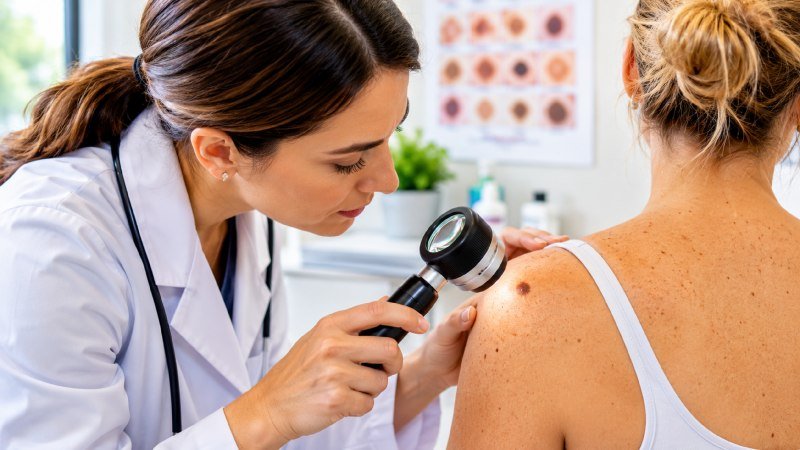
Colour variation inside a mole, asymmetry in border structure, and subtle differences in tone are all features that become far more visible under dermoscopy. Research in the British Journal of Dermatology has found that unaided visual inspection by a non-specialist misses a meaningful proportion of melanomas that dermoscopic examination catches. That is not about how carefully someone is looking. It is about what the method can actually reveal.
There are practical coverage gaps too. The back, the back of the scalp, between the toes, and under the nails are all difficult to examine without help. Skin cancers in those areas tend to be found later for exactly that reason. And there is a familiarity effect: something that has been there for years blends into the background, so slow changes can go unnoticed simply because no single shift is dramatic enough to register.
What a Skin Clinic Assessment Changes
A skin clinic Neutral Bay appointment covers the full body surface, including the areas most people have not looked at properly. Dermoscopy is applied to any lesion that warrants it, not just the ones you came in asking about. The clinician’s focus is specifically on skin cancer detection, so the threshold for flagging something for monitoring is set differently than in a general practice context.
Documentation makes a real difference here too. Total body photography creates a baseline that future visits can be compared against accurately. A lesion that has been stable for three years is reassuring when there is a record behind that conclusion. One that has shifted even slightly since the last photograph can be acted on early, rather than being noticed later when it is harder to manage.
Who Has the Most to Gain from a Check
If you grew up in Australia before the mid-1990s, you spent your formative years in the sun before SPF 30+ was standard advice. That generation carries a higher lifetime UV load than younger cohorts and has the most to gain from regular professional assessment.
Beyond exposure history, certain factors raise the risk profile further: a personal or family history of melanoma or non-melanoma skin cancer, skin that burns easily, a high mole count (generally above 50), a previous diagnosis of actinic keratoses, or a history of bad blistering sunburns in childhood.
The Cancer Council Australia recommends regular professional checks for people with elevated risk factors. How often depends on your individual circumstances and is best worked out after an initial assessment.
Frequently Asked Questions
How often should I get a professional skin check? For people with no significant risk factors, an annual or biennial check is a reasonable starting point. For those with elevated risk, a clinician may recommend every six to twelve months. The right interval is something to establish after an initial assessment rather than decide from general advice alone.
Can a skin clinic detect skin cancer before symptoms appear? Yes. Dermoscopy and systematic full-body examination are specifically designed for this. Many melanomas and some non-melanoma skin cancers are identifiable at a stage when they are not yet visible to the naked eye and are not causing any noticeable symptoms.
Is a skin cancer check the same as a full-body skin check? The terms are often used interchangeably, but it is worth confirming when you book that the check covers the full body surface, including areas not typically examined in a GP appointment.
What if I notice a spot changing between appointments? Do not wait for the next routine check. Any lesion that changes in size, shape, or colour, or that bleeds without obvious cause, warrants a specific appointment rather than a note to mention months later.
Having a history of UV exposure does not mean the outcome is set. Most skin concerns, when found early, are straightforward to manage. A professional check simply gives you an accurate picture of where things stand, which is a better position to be in than not knowing.


