
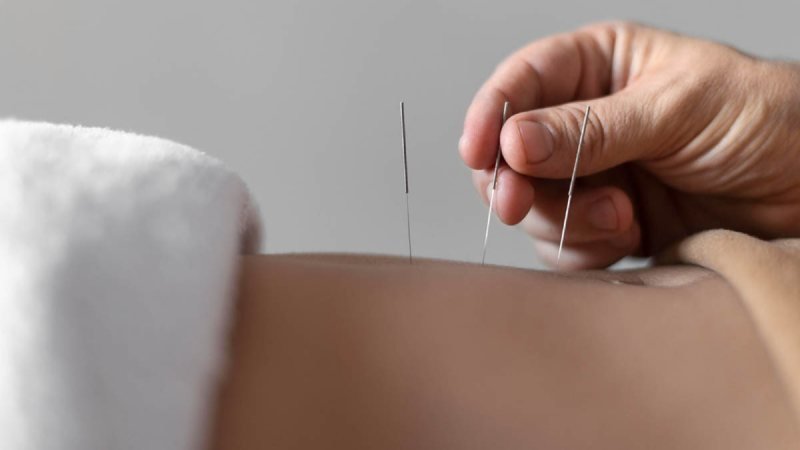
Dry needling is a hands-on physical therapy technique that uses fine sterile needles to release tight muscle trigger points and reset the nervous system around them. It is not acupuncture, it is not painful in the way patients often fear, and most people feel measurable relief after a session or two.
If your shoulder, neck, hip or jaw has been tight for weeks or months and stretching, massage and ice are not moving it, the muscle is probably stuck in a contraction it cannot release on its own. The medical term is a myofascial trigger point. Roughly 85 percent of patients seen for chronic musculoskeletal pain have at least one. Dry needling is the most direct way to release them.
How dry needling actually works
Your therapist locates a trigger point by palpating the tight band of muscle. A fine, sterile single-use needle is inserted directly into the band. Often the muscle produces a small involuntary twitch, called a local twitch response. That twitch is the muscle releasing. The therapist may move the needle gently or leave it in place for several seconds to a few minutes.
What is happening biologically: the needle insertion mechanically disrupts the trigger point, increases local blood flow, and triggers a neuromuscular reset that allows the muscle to return to its resting length. A 2024 systematic review in the Journal of Orthopaedic and Sports Physical Therapy found dry needling reduced pain intensity by an average of 30 to 40 percent in patients with chronic neck and shoulder pain, often within hours of a single session.
Who benefits most
Dry needling helps people with chronic neck pain, shoulder impingement, tension headaches, jaw pain, hip tightness, low back pain, plantar fasciitis, tennis and golfer’s elbow, calf tightness in runners, and the knotted shoulder muscles that desk workers carry around year-round.
Patients where stretching and massage have not produced lasting change are usually the strongest candidates. The trigger point is often too deep for surface work to reach. Dry needling gets to it directly.
Patients with active referred pain often respond dramatically. A trigger point in the shoulder that creates a headache, a hip trigger point that mimics sciatica, a forearm trigger point that aches all the way into the fingers, all release upstream when the right needle hits the right band.
What to expect during a session
Your first session at Rebalance starts with conversation, not the needle. We discuss your history, your specific pain pattern, what you have already tried, and any concerns about needles. We then assess the area, palpate for trigger points, and explain exactly what we are about to do before we do it. Consent first, always.
The needle insertion itself feels like a quick pressure, sometimes nothing at all. When the needle finds the trigger point and the muscle twitches, there is a brief deep ache or cramping sensation, usually lasting one to two seconds. Most patients describe it as satisfying rather than painful, especially in a muscle they have been fighting with for months.
A typical area takes a few minutes. Multiple trigger points or multiple areas can be treated in one session. A full session is usually 30 to 60 minutes including assessment, treatment, and education on what to do at home.
What to expect afterwards
The treated area is often sore for 24 to 48 hours, similar to the feeling after a hard workout. You may notice immediate improvement in range of motion, sometimes a delayed improvement that builds over the next two to three days. Light bruising occasionally happens and resolves quickly.
Drink water, move gently, and avoid intense workouts for the first 24 hours. As Hina Sheth, founder of Rebalance PT and a board-certified manual therapist, often tells patients: “If you feel sore the day after dry needling, that’s the muscle reorganising. If you feel worse a week later, something else is going on. Tell us.” The first reaction is normal. The second is a signal to call.
How dry needling differs from acupuncture
Same needles, completely different framework. Acupuncture is rooted in Traditional Chinese Medicine and works along meridian lines. Dry needling is a Western musculoskeletal intervention that targets specific anatomical structures, trigger points, muscle bands, occasionally nerves, for a specific outcome: release, pain reduction, restored function. The training pathway, the credentials, the rationale, and the expected outcomes are different. Both can be valuable. They are not interchangeable.
How many sessions you need
For a single acute trigger point, one to three sessions often resolves it. For chronic pain patterns with multiple involved muscles, four to eight sessions across a few weeks is the more realistic plan.
We always combine dry needling with manual therapy, movement retraining and a short home program. The needle releases the trigger point. The follow-up work and myofascial release prevents it coming back. Releasing the muscle without addressing what made it tight in the first place is a recipe for the trigger point returning in three months.
When to come in
If you have been carrying a knot in your shoulder, neck or hip for weeks or months and nothing else has touched it, dry needling is one of the most reliable interventions we offer. We treat patients across Philadelphia and the Main Line, with clinics in Center City and Narberth.
Book a free 15-minute phone consultation with our team, or read more about our dry needling therapy approach. The consult is a no-pressure call to see if dry needling is the right fit for what you are dealing with.