
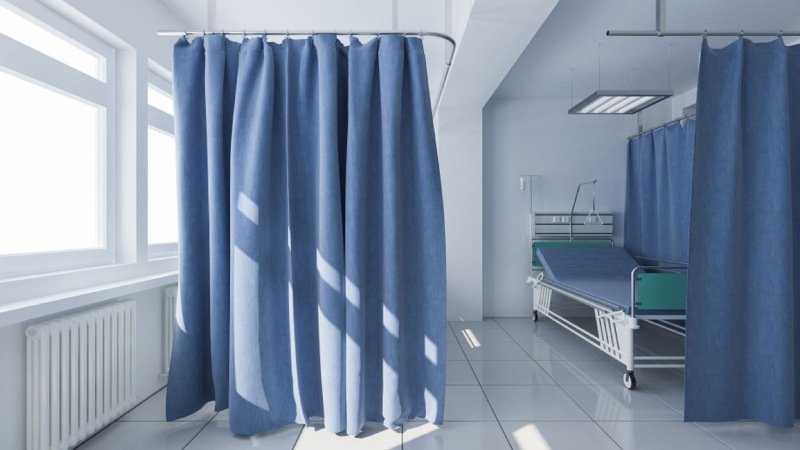
Why Hospitals Are Replacing Privacy Curtains More Frequently Than Ever?
Hospital staff touch privacy curtains more frequently than almost any other surface in patient care environments, yet healthcare facilities often give them less attention than bed rails, door handles, IV pumps, and other high-contact equipment. Every day, patients, visitors, nurses, physicians, therapists, and environmental services (EVS) teams touch these curtains while moving through healthcare facilities. Because of this constant interaction, privacy curtains can quickly become reservoirs for microorganisms if healthcare staff do not replace or clean them regularly.
As hospitals continue strengthening infection prevention strategies, many healthcare organizations are taking a closer look at how often they should replace privacy curtains and whether their current curtain systems support efficient maintenance. Recent research, combined with increasing operational demands, has encouraged facilities to move toward more practical curtain replacement processes that minimize disruption while improving compliance with infection control protocols.
Today, healthcare facilities no longer view replacing hospital privacy curtains as a simple housekeeping task. Instead, they recognize it as an important component of environmental hygiene and patient safety.
Why Privacy Curtains Matter in Infection Prevention?
Hospital privacy curtains serve an essential role by providing dignity and confidentiality for patients during examinations, treatments, and recovery.However, manufacturers make privacy curtains from fabric, and patients, visitors, and healthcare staff touch them repeatedly throughout the day. As a result, they can easily collect bacteria, viruses, and other contaminants.
Unlike hard surfaces that environmental services (EVS) staff disinfect multiple times a day, routine cleaning often overlooks privacy curtains because laundering or replacing them requires additional time and resources. This allows microorganisms to remain on curtain surfaces for extended periods.
Curtains located near patient beds are particularly vulnerable because healthcare workers frequently move them before and after providing care. Patients and visitors also touch curtain edges when entering or leaving bed spaces, making them one of the highest-contact fabric surfaces within hospitals.
While privacy curtains themselves are not necessarily the direct cause of healthcare-associated infections (HAIs), reducing contamination on frequently touched surfaces remains an important part of comprehensive infection prevention programs.
How Quickly Do Hospital Privacy Curtains Become Contaminated?
Research published in the American Journal of Infection Control found that bacterial contamination on hospital privacy curtains can increase within days of installation. In the study, researchers observed a noticeable rise in bacterial levels during the first two weeks, with MRSA detected on some curtains between days 10 and 14.
While replacement policies vary by healthcare facility, the findings reinforce one important principle: healthcare facilities should treat privacy curtains as part of routine environmental hygiene rather than simply as a privacy barrier.
For infection prevention teams, consistent curtain replacement is just as important as cleaning other frequently touched surfaces.
Why Is Curtain Replacement Often Delayed?
The challenge is rarely a lack of awareness. Instead, it’s the process itself.
Traditional hospital privacy curtains are attached to ceiling tracks using hooks or snap systems. Replacing them typically requires a ladder, overhead work, and valuable staff time. Depending on the room layout, changing a single curtain can take anywhere from 20 to 40 minutes.
In busy hospitals where EVS teams are responsible for patient discharges, terminal cleaning, and emergency room turnover, curtain replacement can easily become a lower priority.
As a result, replacement schedules may be delayed even when infection prevention policies recommend more frequent changes.
How Quick-Change Curtain Systems Improve Hospital Efficiency
To reduce downtime, many healthcare facilities are adopting quick-change hospital privacy curtains that separate the removable fabric panel from the ceiling-mounted header.
Instead of removing the entire curtain assembly, staff simply unzip the fabric panel and attach a clean replacement while the header remains on the existing track. This eliminates the need for ladders, reduces overhead work, and allows a single staff member to complete the task in less than a minute.
Beyond saving time, quick-change systems help hospitals maintain routine replacement schedules without disrupting patient care or room availability.
Healthcare facilities evaluating hospital privacy curtains are increasingly considering replacement efficiency alongside traditional factors such as durability and flame resistance.
Benefits Beyond Time Savings
The advantages of quick-change curtain systems extend well beyond reducing replacement time.
Healthcare facilities often report improvements such as:
Improved Staff Safety
Eliminating ladders reduces the risk of slips, falls, and overhead injuries for environmental services personnel.
Better Compliance
When curtain replacement becomes easier, hospitals are more likely to follow recommended replacement schedules consistently.
Reduced Room Downtime
Faster replacements allow patient rooms to return to service more quickly after cleaning or discharge.
Lower Labor Requirements
A task that previously required significant staff time can often be completed by a single employee with minimal disruption.
Increased Operational Flexibility
Hospitals can replace curtains whenever needed instead of waiting until sufficient staffing or equipment becomes available.
Disposable or Reusable: Which Is Better?
Both reusable and disposable curtain systems have advantages depending on the healthcare setting.
Reusable curtains remain a cost-effective choice for general patient rooms where laundering is part of normal operations. Disposable curtains, however, are becoming increasingly common in isolation rooms, emergency departments, and outbreak response areas where rapid replacement is essential.
Many hospitals now use a combination of both approaches to balance operational efficiency with infection prevention goals.
Facilities exploring disposable hospital curtains often deploy them in high-risk environments while continuing to use reusable curtains in standard patient care areas.
Small Operational Improvements Can Deliver Significant Results
Hospital efficiency isn’t always driven by large infrastructure projects. Often, improving routine maintenance tasks can have a meaningful impact on workflow, compliance, and staff productivity.
Reducing curtain replacement from 30 minutes to less than one minute allows environmental services teams to spend more time supporting patient care and less time performing repetitive maintenance.
Solutions such as ZipQuick Curtains demonstrate how modern curtain systems can simplify routine operations without requiring hospitals to replace their existing ceiling track infrastructure.


