
Why Tocotrienols May Support Heart Health Better Than Tocopherols
The molecular structure of tocotrienols allows them to navigate cell membranes more freely and reach the tissues more effectively, which is why they may exert stronger cardiovascular effects than tocopherols. Although both are members of the vitamin E family, their differing behavior inside the body has spurred scientists to focus more on tocotrienols as agents for heart and blood vessel protection.
On the vitamin E supplement shelves, you will mostly find products containing only alpha-tocopherol. This form has been the main player in the field of vitamin E for decades. But, tocotrienols are the lesser-known members of this vitamin family and recent studies indicate that they are capable of performing various heart-related functions which tocopherols do either very weakly or not at all. That means it is important to understand the distinction if your goal is to find a supplement that offers cardiovascular benefits rather than one that simply covers the vitamin E requirement.
What Actually Separates Tocotrienols From Tocopherols
Vitamin E isn’t just one compound. It consists of a group of fat-soluble molecules: four tocopherols and four tocotrienols, each present as alpha beta gamma, and delta. The chemistry may sound boring, yet one detail performs a lot of work. Tocotrienols have an unsaturated tail with three double bonds, whereas tocopherols have a saturated, stiffer tail.
This structural difference results in different movements of each one. The pliable tail of tocotrienols allows them to spread more uniformly within the fatty layers of cell membranes, which is approximately where a lot of oxidative damage occurs. Studies have characterized tocotrienols as more powerful antioxidants in membrane environments, and some experiments suggest that their antioxidant activity in certain situations might be A lot higher than that of alpha-tocopherol. Determining whether this corresponds to a constant multiple in live humans is more challenging, but the mechanism is genuine and frequently observed.
There is also the matter of absorption. Compared to alpha-tocopherol, which the liver retains using a transfer protein, tocotrienols are absorbed and removed from the body rather rapidly. So not only do these two forms behave differently, but they also have different lifetimes after you take them.
The Cholesterol and Artery Connection
The most widely deliberated cardiovascular topic related to tocotrienols is their impact on cholesterol synthesis. Tocotrienols, mainly the gamma and delta variants, seem to inhibit an enzyme called HMG-CoA reductase, which is also the target of statin drugs. They do this via a milder, more self-regulating mechanism, whereby the body is prompted to degrade the enzyme rather than having it blocked completely.
Human trials on this topic have yielded varying results, so it is good to highlight that. Some of the research showed drops in total and LDL cholesterol by approximately 10 to 20 percent, but other studies showed very little change. These differences usually happened because of different dosages, the specific tocotrienol combination, and whether tocopherol was present alongside it or not. The last factor has been frequently mentioned. Higher amounts of alpha-tocopherol seem to hamper tocotrienols’ cholesterol effect, which is one of the reasons why the source and formulation of a supplement are so important.
Besides cholesterol, scientists have become interested in the effects of tocotrienols on arteries in general. There is some early research that associates taking tocotrienol with less arterial stiffness and with slowing down carotid artery plaque development in small studies done for several years. These are the first hints rather than final proofs, but they indicate the artery wall itself, not only the figures on a blood panel.
Why the Tocopherol Content of Your Supplement Matters
Here’s the real snag that confuses a lot of others. If you purchase a tocotrienol supplement that also has quite a few alpha-tocopherol, you might be weakening the very advantage that you purchased it for. Research shows that high levels of alpha-tocopherol can lessen tocotrienols’ effects on reducing cholesterol and might rival tocotrienol absorption.
This is why formulation deserves a careful read of the label. A product built around tocopherol-free tocotrienols is designed specifically to avoid that interference, delivering the tocotrienol fraction without the competing tocopherol load that can blunt the result. If your goal is cardiovascular support specifically, that distinction is more than marketing. It reflects an actual interaction observed in the research.
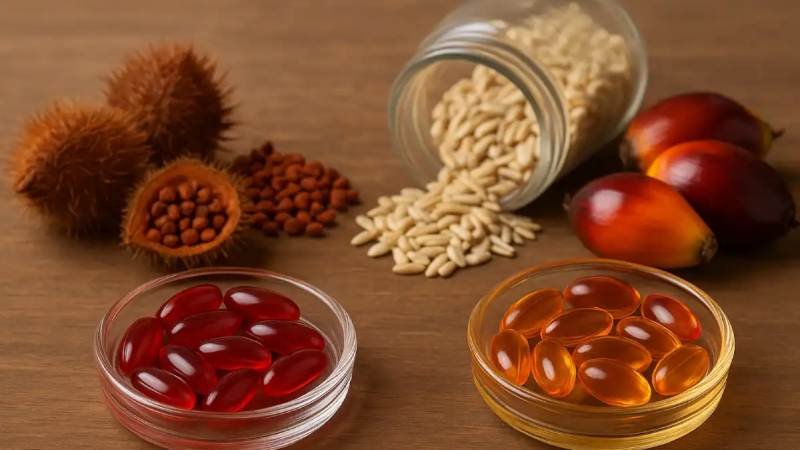
Tocotrienols are mostly extracted either from annatto or palm. It is mainly worth mentioning that annatto-derived tocotrienols are naturally very close to 90 percent delta and 10 percent gamma with almost no tocopherol, whereas palm and rice bran sources generally have a more mixed composition that also includes tocopherol. By simply knowing the origin, you already have a pretty good idea of what you are going to get, even before checking the supplement facts panel.
What This Means If You Are Choosing a Supplement
In the studies, researchers usually administer doses of 100 to 300 milligrams of tocotrienols per day, with most cardiovascular trials using the 200 to 300 milligram range taken with food, since dietary fat improves the absorption of these fat-soluble compounds.Taking them on an empty stomach is one of the simplest errors to make, and also one of the easiest to correct.
What matters is how your case changes the relevance of any of this. A person with normal cholesterol and no family history might simply want general antioxidant support, so the tocotrienol vs. tocopherol discussion is a nice-to-know but not must-know. A person whose lipid panel is gradually increasing, or who has a family history of heart disease, is more likely to focus on the specific form and on whether tocopherol is crowding it out. And the person already on a statin should see tocotrienols, talking to a doctor rather than switching them, since both affect the same enzyme pathway.
Price is definitely something to think about, too. Annatto tocotrienols without tocopherol tend to be more expensive than a simple alpha-tocopherol capsule, partly because the extraction is more complicated and the raw material is less abundant. You are buying a more specific compound, not just vitamin E dressed differently. Whether this extra cost is worth it depends on what you want to achieve, which is a better question than asking which form is better for everybody.